
Garage Floor Paint in San Diego: Types, Costs, and What Actually Lasts
Joe Penney has been painting in San Diego County since 2007 and in the trade for over 35 years. Every job — residential, commercial, and specialty coatings — is run by Joe or his son Alex personally. No subcontractors, no franchise crews. CA License #794402-C33.
Quick answer
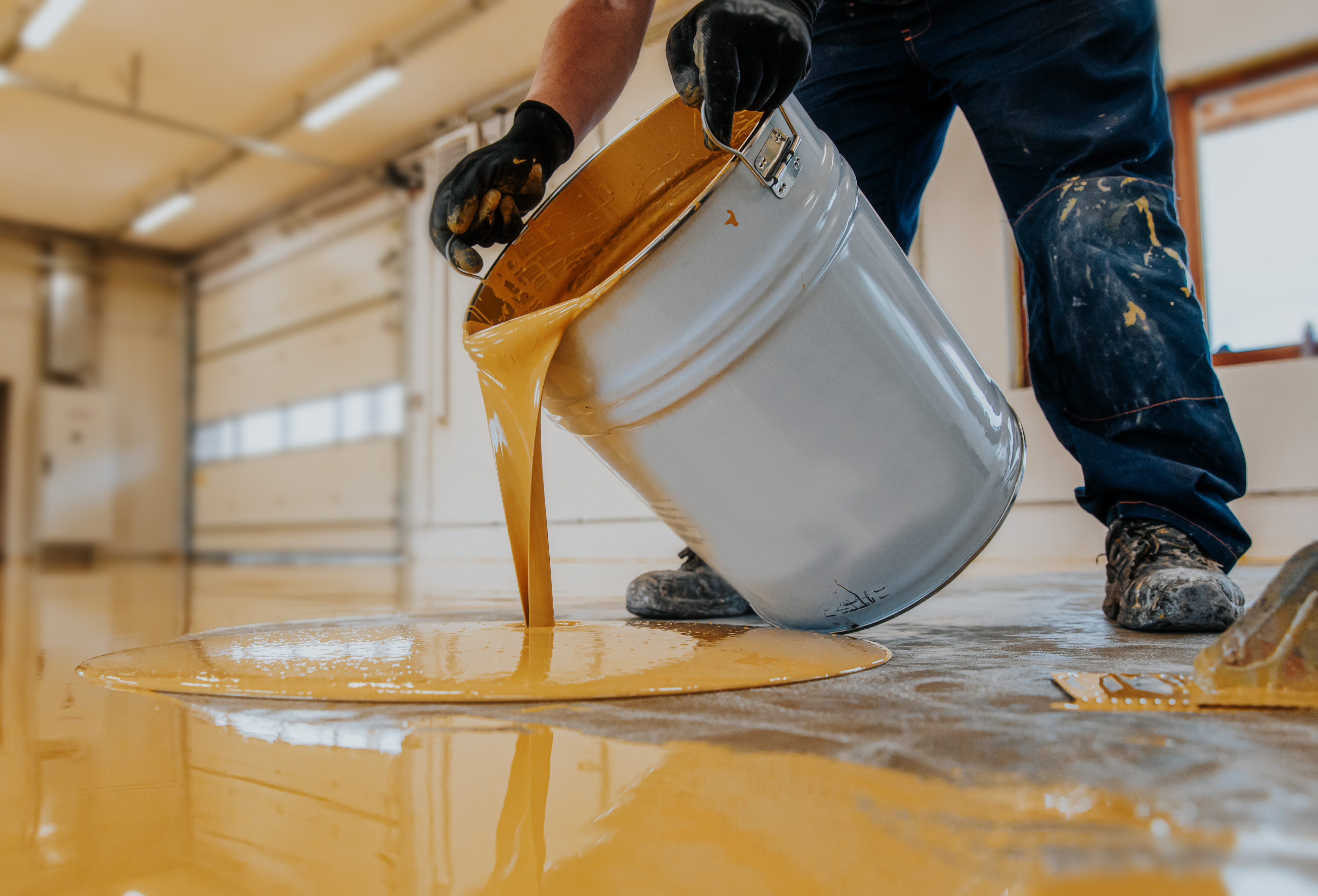
Garage floor paint ranges from $1–$3 per square foot installed for basic concrete paint up to $5–$12 per square foot for professional polyurea systems. For most San Diego homeowners, a 100% solids epoxy with polyaspartic topcoat — professionally installed at $4–$7 per square foot — is the right middle ground between cost and a coating that actually holds.
The garage floor is the one floor in your house you cannot hide with a rug — which is probably why so many people keep putting this project off. If you are searching "garage floor paint," you will find everything from $40 box-store kits to $6,000 professional installs, and the marketing on all of it is equally optimistic about how long it will last. Here is a straight account of what the options actually are, what they cost in San Diego, and where most of these projects go wrong.
We have been applying epoxy, polyurethane, and specialty coatings in San Diego County since 2007 — residential garages, commercial warehouses, HOA carports. What we have seen fail, and why, is more useful than any product spec sheet.
What "garage floor paint" actually means
Walk into any home improvement store and you will find three or four products all labeled some variation of "garage floor paint" or "floor coating." They are not the same product, and the performance difference between them is significant.
The term covers a spectrum. At one end: basic latex or acrylic concrete paint — the same chemistry as wall paint, reformulated to sit on a horizontal surface. At the other end: professional 100% solids epoxy systems with a polyurea or polyaspartic topcoat. The box store product and the professional system are both technically "garage floor paint." They do not perform remotely alike.
For this guide, "garage floor paint" means the full range — from the $40 quart to the professional multi-coat system. We will break down where each option fits and where it does not.
Paint vs epoxy: what the labels don't tell you
The word "epoxy" on a consumer product label is not a guarantee of a specific chemistry. Many products sold as "epoxy floor paint" or "epoxy garage paint" at hardware stores are water-based latex with a small percentage of epoxy resin added. They are easier to apply than true epoxy and clean up with water — but they do not build the film thickness or bond strength of a real two-part epoxy system.
A true two-part epoxy mixes a resin with a hardener, triggering a chemical cure — not a simple drying process. The result is a significantly harder, denser film that bonds chemically to properly prepared concrete. Water-based "epoxy paint" air-dries like conventional paint. The difference shows up within 2–3 years on a garage floor that sees regular vehicle traffic and the occasional oil drip.
The practical rule: if the product is ready to use straight from the can with no mixing, it is paint — regardless of what it says on the label. If it requires mixing Part A and Part B before application, it is an epoxy system.
Types of garage floor coatings compared
There are five categories worth knowing. From lowest cost and shortest lifespan to highest cost and longest lifespan:
| Type | Cost (installed) | Lifespan | Best for |
|---|---|---|---|
| Concrete paint (latex/acrylic) | $1–$3/sq ft | 1–3 years | Low-traffic, tight budget, short-term cosmetic |
| Water-based epoxy paint | $2–$4/sq ft | 2–5 years | Light residential use, DIY-friendly |
| 100% solids epoxy (base only) | $3–$5/sq ft | 7–12 years | Standard residential garage, good prep |
| Epoxy base + polyaspartic topcoat | $4–$7/sq ft | 10–20 years | Most residential and light commercial garages |
| Full polyurea/polyaspartic system | $5–$12/sq ft | 15–25 years | High-traffic, commercial, best UV resistance |
A note on concrete stain: stains penetrate the slab and change its color permanently but add no protective film. They are a decorative option, not a protective coating. If your goal is resisting oil, chemicals, and tire marks, stain alone is not the answer.
The same chemistry applies to basement floor paint — the products are identical, the main variable being that basement slabs often have higher moisture vapor transmission than garage slabs. In San Diego, coastal garages present a similar moisture challenge.
How much does garage floor coating cost in San Diego?
A standard two-car garage in San Diego is 400–500 square feet. Using that as the baseline:
| Option | DIY total cost | Professional total cost |
|---|---|---|
| Concrete paint | $60–$150 materials | $400–$1,500 |
| Water-based epoxy kit | $150–$300 materials | $800–$2,000 |
| 100% solids epoxy (base only) | $400–$600 + grinder rental | $1,200–$2,500 |
| Epoxy base + polyaspartic topcoat | $600–$900 + grinder rental | $1,600–$3,500 |
| Full polyurea system | Not practical for DIY | $2,000–$6,000 |
The largest variable in professional pricing is surface prep — shot blasting, diamond grinding, crack repair, and moisture mitigation add cost that a simple square-footage quote often omits. Get a written scope that itemizes prep separately from coating application before comparing bids.
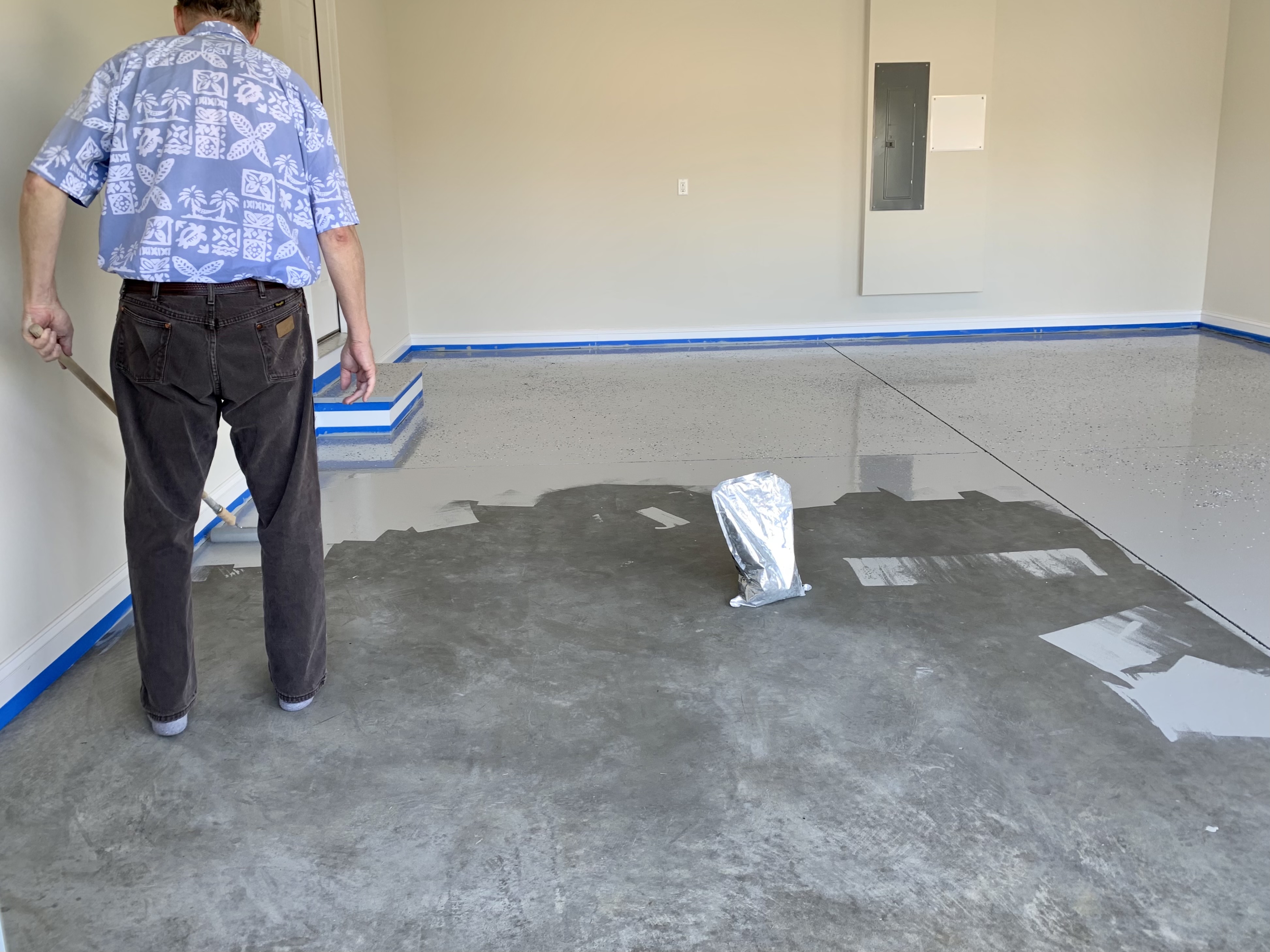
DIY costs above assume you own or can borrow the right equipment. For a true 100% solids epoxy or polyurea system, a diamond grinder is not optional. Rental runs $80–$150 per day. Acid etching alone does not open the concrete pores sufficiently for a proper mechanical bond on most San Diego slabs.
How long does garage floor paint last?
Concrete paint: 1–3 years under vehicle traffic before it starts to wear through. In a high-UV environment like San Diego, fading begins within the first year on south- and west-facing garages.
Water-based epoxy: 2–5 years, again depending on traffic and prep quality. The UV sensitivity of water-based epoxy formulations is a real factor in San Diego — most are not UV-stable and yellow noticeably within 18 months in direct sun. If your garage door faces south or west, this matters.
A properly installed 100% solids epoxy base with a UV-stable polyaspartic topcoat lasts 10–20 years in residential use. The polyaspartic top layer handles UV resistance, scratch resistance, and hot tire resistance that a bare epoxy base coat does not have on its own.
Full polyurea systems are the most durable option available — commercial installations regularly reach 15–25 years before needing attention. The tradeoff is cost and the fact that polyurea cures extremely fast, leaving very little room for error during application. It is not a DIY product.
One number worth remembering: a 20-year cost analysis comparing concrete paint (reapplied every 2–3 years) against a professional epoxy-polyaspartic system typically shows the professional system is cheaper over 20 years, even before factoring in the labor of repeated DIY recoats.
Surface preparation: the step that decides everything
Garage floor coatings do not fail because of the product. They fail because of preparation. Nearly every premature peel, delamination, or hot tire pickup failure traces back to one of three prep problems.
Insufficient surface opening. Concrete must be mechanically opened — ground or shot-blasted to a surface profile that gives the coating something to grab. Acid etching alone produces an inconsistent profile and leaves behind contaminants. On a previously sealed or painted slab, acid etching does almost nothing. Diamond grinding is the right tool for most residential garages.
Surface contamination. Oil, grease, and silicone from tire dressings penetrate deep into concrete. They must be degreased and removed before grinding — not just ground over. A contaminated slab that looks clean after grinding will reject a coating within months.
Moisture vapor transmission. Concrete slabs wick moisture from the ground. If the moisture vapor emission rate is too high, a coating applied over it will blister and peel from below — not from above. A simple plastic sheet tape test (48–72 hours) will indicate whether the slab has a moisture problem before you apply anything. Coastal San Diego slabs, particularly in areas with shallow water tables, are worth testing.
Any contractor who does not mention moisture testing, propose diamond grinding, and address visible cracks and spalls in the written scope is quoting you an incomplete job.
DIY vs professional garage floor coating
The honest answer: DIY is viable for water-based epoxy kits, but the results are not comparable to a professional 100% solids system. If you are willing to do the prep correctly — rent the diamond grinder, degrease thoroughly, test for moisture — a quality DIY water-based epoxy kit will give you 3–5 years of reasonable performance for $150–$300 in materials.
Where DIY fails is in the prep shortcuts. Most homeowners do the acid etch, skip the grinder, and apply the kit the same weekend. The coating looks fine for the first year. By year two, hot tire marks and edge peeling start. By year three, the floor is worse than when they started because there are now two layers to remove.
For a system expected to last 10–20 years, professional installation is worth the cost. Not because the product is unavailable to consumers, but because the prep equipment, product knowledge, and application conditions are difficult to replicate on a one-time basis. We have re-coated enough DIY jobs to have a strong opinion on this.
If you are going to DIY, the American Concrete Institute publishes preparation standards for concrete coatings (ACI 308R) that are worth reading before you start. The California Contractors State License Board also has guidance on verifying a contractor's license for any professional work over $500 — our license is CA #794402-C33.
San Diego-specific factors: UV, heat, and marine layer
San Diego is not a neutral environment for garage floor coatings. Three factors affect product selection and application timing that most national guides do not address.
UV exposure. San Diego averages 266 sunny days per year. Water-based epoxy formulations are not UV-stable — they yellow, chalk, and fade with prolonged sun exposure. A garage that faces south or west with the door open regularly is guaranteed to see UV degradation on a water-based system within 18–24 months. A UV-stable polyaspartic topcoat prevents this. If someone quotes you a single-coat water-based system on a sun-exposed garage, ask specifically about UV resistance.
Summer heat. Inland San Diego — La Mesa, El Cajon, Santee, Poway — regularly sees summer temperatures above 90°F. Concrete surface temperatures in an enclosed or south-facing garage can reach 100°F or higher. Most epoxy products have an application temperature ceiling of 85–90°F surface temperature. Applying above that ceiling causes bubbling, thin film build, and significantly reduced adhesion. Professional installers on inland San Diego jobs in summer start at 6–7 AM to beat surface temperatures.
Marine layer and coastal moisture. Coastal San Diego (Del Mar, La Jolla, Encinitas, Ocean Beach) sees significant marine layer through June and July. Concrete that feels dry to the touch can still have elevated surface moisture from overnight fog. Applying any coating to a surface with greater than 4% moisture content by weight — as measured by a calibrated moisture meter, not by hand — risks blistering and delamination. Coastal slab moisture vapor testing is not optional; it is the difference between a 10-year job and a 1-year callback.
Hot tire pickup. San Diego summer temperatures make hot tire pickup worse than in cooler climates. A bare 100% solids epoxy base coat without a polyurethane or polyaspartic topcoat will stick to vehicle tires in peak summer heat. This is almost always a topcoat omission problem, not a base coat failure. For any garage floor coating in San Diego, the system must include a hard topcoat rated for hot tire resistance.
What the application process actually looks like
A professional garage floor coating job runs 2–3 days. Here is what that time covers:
Day 1 — Prep. Diamond grinding the entire slab to open the surface profile. Degreasing and cleaning oil contamination. Crack and spall repair. Moisture testing. This is the majority of the labor cost and the step that determines how long the finished floor lasts.
Day 2 — Base coat. Epoxy base coat mixed and applied — rolling the field, cutting corners, adding decorative flake broadcast if specified. The base coat requires a minimum cure window before topcoat can be applied.
Day 3 — Topcoat and cure. Polyaspartic or polyurethane topcoat applied over cured base. Light foot traffic is typically possible within 12–24 hours. Vehicle traffic requires 48–72 hours of full cure. Professional polyaspartic systems can compress this timeline significantly — some installations allow vehicle traffic within 24 hours.
The EPA's guidance on VOCs and indoor air quality is worth reading if you are sensitive to chemical exposure. Solvent-based epoxy and polyurea products have significant VOC content during application; ventilation is required. Waterborne systems are lower-VOC and suitable for partially enclosed spaces with standard ventilation.
When you should not coat your garage floor
There are jobs we look at and recommend against coating. Not because we cannot do the work — because the coating will fail.
Active moisture vapor transmission. If the plastic sheet test shows condensation forming within 24–48 hours, the slab has a moisture problem that a coating will not solve. It will trap moisture below the coating and peel within months. The right fix is a moisture mitigation primer system — which adds cost and complexity, and is not always the right call economically. We will tell you which situation you are in.
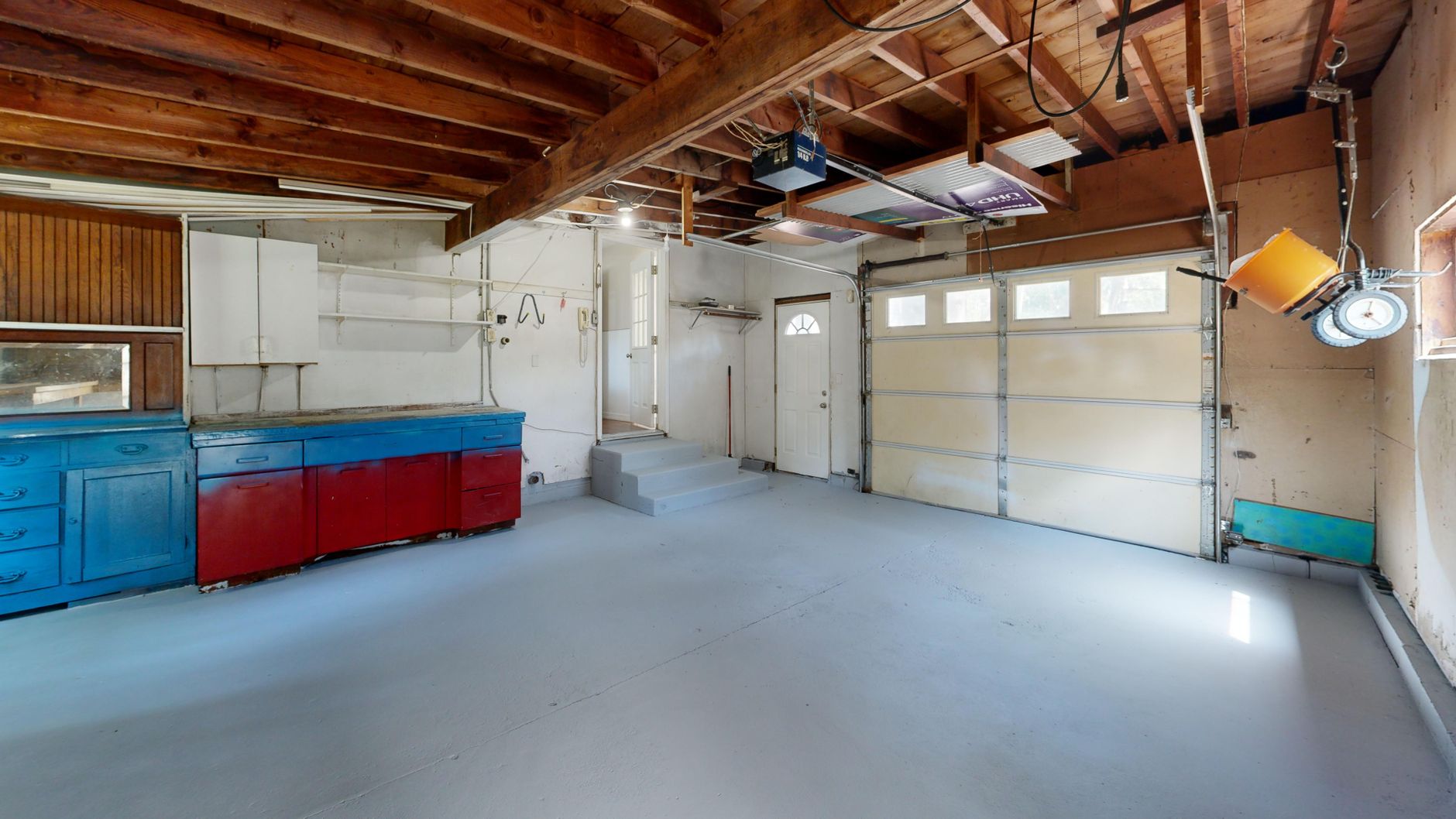
Existing failed coating you cannot fully remove. A new coating over an old one bonds to the old layer. When the old layer fails, the new one goes with it. If a previous coating is peeling, flaking, or partially lifted, it must come off completely before anything new goes down. If removal is not feasible — because the slab surface is too damaged — we will tell you that instead of coating over the problem.
Structural cracks. Hairline shrinkage cracks are normal and can be filled before coating. Cracks that are still moving — seasonal expansion and contraction, or settlement — will reflect through any rigid coating system. No epoxy or polyurea film will bridge an active crack indefinitely. If your slab has cracks wider than 1/8 inch or cracks that show differential height, get a structural assessment before spending money on a surface coating.
Very low budget. If the budget does not cover proper prep, the job will not last. A rushed application of a water-based kit over an unprepared slab is money spent twice — once for the kit and once for the re-do. We would rather tell you to wait until the budget is there than produce a floor that fails in 18 months.
If any of these situations describe your project, the right call is a conversation before a quote. We do not bill for that conversation: reach us directly and we will give you a straight answer.
For other coating work — exterior elastomerics, specialty commercial finishes, and interior painting in San Diego — we apply the same prep-first approach. Our full epoxy garage floor guide covers the epoxy system in more depth if you have already decided on epoxy over standard paint. For commercial garages, carports, and parking structures, see our commercial exterior painting services.
FAQ
What is the best garage floor paint?
For durability in San Diego, a 100% solids epoxy base with a UV-stable polyaspartic topcoat is the best-performing system for most residential garages. It handles hot tires, UV exposure, oil, and heavy foot traffic better than any single-coat product. For a purely cosmetic short-term refresh on a light-use garage, a quality concrete paint from Sherwin-Williams or Dunn-Edwards is less expensive and easier to apply — with the expectation that it will need refreshing within 2–3 years.
How much does it cost to paint a garage floor in San Diego?
Professionally installed garage floor coating in San Diego ranges from $400–$1,500 for basic concrete paint on a two-car garage up to $1,600–$3,500 for a full epoxy-polyaspartic system. DIY materials run $60–$900 depending on the system. The biggest cost variable is surface prep — a garage with contaminated or previously coated concrete costs more to prepare.
Is epoxy paint the same as epoxy floor coating?
No. Products labeled "epoxy paint" at home improvement stores are typically water-based latex with a small epoxy additive. True epoxy floor coating is a two-part system — resin plus hardener — that chemically cures to a significantly harder, more durable film. The application difference is that epoxy paint air-dries, while a two-part system requires mixing and has a limited working time after mixing.
How do I prepare a garage floor for painting?
The correct sequence: degrease all oil contamination, diamond grind the surface to open the concrete profile, vacuum and clean thoroughly, test for moisture vapor, and fill cracks and spalls with appropriate filler. Acid etching can supplement but should not replace mechanical grinding on a previously sealed or contaminated slab. Do not apply any coating to a surface testing above 4% moisture content by weight.
Why is my garage floor paint peeling?
Almost always preparation failure: the concrete was not opened sufficiently, there was residual oil contamination, or moisture vapor was pushing through from below. Hot tire pickup — where tires pull the coating off on hot summer days — is a topcoat problem, not a base coat problem. It indicates either no topcoat was applied or the topcoat was not rated for hot tire resistance. In San Diego, with summer garage temperatures regularly exceeding 90°F, hot tire resistance in the topcoat is not optional.
How long do I need to stay off a freshly painted garage floor?
For foot traffic: 12–24 hours for most professional systems. For vehicle traffic: 48–72 hours minimum for epoxy, 24 hours for fast-cure polyaspartic systems. Full chemical cure — meaning the coating has reached its full hardness and chemical resistance — takes 7 days for most epoxy systems, regardless of when it feels dry to the touch. Avoid rolling heavy equipment or dragging sharp metal across the floor for that first week.
Can I paint over an existing garage floor coating?
Only if the existing coating is fully adhered, completely clean, and the new coating is compatible with it. Applying over a peeling or failing coating transfers the failure mode to the new layer — when the old coating lets go, the new one comes with it. The correct approach is to test adhesion of the existing coating, grind it off if adhesion is questionable, and start with bare concrete.
Does garage floor paint work in coastal San Diego?
Yes, with the right preparation. Coastal San Diego slabs — particularly in areas near the ocean in Del Mar, La Jolla, Encinitas, and Ocean Beach — are more likely to have elevated moisture vapor transmission and marine layer condensation on the surface. Moisture testing before application is non-negotiable on coastal jobs. Schedule application on a clear afternoon with confirmed dry conditions, not after a night of coastal fog.
Penney's Professional Painting — garage floor coatings, interior, and exterior painting across San Diego County since 2007.
We will assess your slab condition, tell you which system is the right fit, and give you a written scope that spells out prep and coating separately — before we quote anything.
Walk the job with Joe or Alex.
Tell us what you're thinking. We'll come look, point out what we'd do differently, and only quote what we'd paint in our own house.