
Exterior Painting Cost in San Diego: What to Expect in 2026
Joe Penney has been painting in San Diego County since 2007 and in the trade for over 35 years. Every job — residential, commercial, and specialty coatings — is run by Joe or his son Alex personally. No subcontractors, no franchise crews. CA License #794402-C33.
Quick answer
Professional exterior painting in San Diego runs $3.50–$5.50 per square foot, or $5,250–$13,750 for a typical 1,500–2,500 sq ft home. Stucco condition is the biggest cost variable. A home with hairline cracks and minimal chalking comes in near the low end. Active cracks, heavy chalking, or a failed prior coating push the number up significantly before a brush touches the surface.
Three quotes for the same exterior paint job in San Diego. The numbers come back at $5,200, $8,400, and $11,900. The house hasn't changed. The weather hasn't changed. The three crews are painting the same 1,800 square feet of stucco — and somehow the spread is $6,700. If you've been there, you know the feeling: one of these people is lying, or incompetent, or both. Usually nobody is lying. The $5,200 quote just left out the prep.
This guide covers what exterior painting actually costs in San Diego in 2026, what drives those costs, and what the low quote is almost certainly skipping. We have been painting San Diego homes and commercial buildings since 2007 — all stucco, all coastal climate, no subcontractors. The numbers below are what we see on actual jobs, not national averages dressed up with a zip code.
What exterior painting costs in San Diego
San Diego exterior painting runs higher than the national average because of three compounding factors: labor costs in a high cost-of-living market, the prevalence of stucco (which requires more prep and primer than vinyl or wood siding), and the expectation of UV- and salt-air-rated paint systems in a coastal county.
Here is the honest range:
- $3.50–$5.50 per square foot — standard professional exterior repaint, stucco in fair to good condition
- $5.50–$7.50 per square foot — multi-story homes, significant stucco repair, complex trim, specialty coatings
- $1.50–$2.50 per square foot — budget-tier contractors, high probability of prep shortcuts
The per-square-foot number refers to the painted surface area — not the home's living area. A 1,800 sq ft single-story home has roughly 1,400–1,600 square feet of exterior paintable surface after accounting for windows and doors. That distinction matters when you're comparing quotes.
Exterior painting cost by home size in San Diego
These ranges are based on homes in fair to good condition with typical stucco repair — minor cracks, moderate chalking, caulking at windows and trim. Homes with significant water damage, failed prior coatings, or heavy stucco cracking will run higher.
| Home Size | Stories | Typical Range (San Diego) |
|---|---|---|
| 1,000–1,500 sq ft | 1 | $3,500–$6,500 |
| 1,500–2,000 sq ft | 1–2 | $5,250–$9,000 |
| 2,000–2,500 sq ft | 2 | $7,000–$12,500 |
| 2,500–3,500 sq ft | 2 | $9,000–$16,000 |
| 3,500+ sq ft | 2–3 | $14,000–$22,000+ |
These are total project costs including labor, materials, surface prep, caulking, and primer. They do not include significant structural stucco repair, elastomeric coatings as a primary system, or roof-line and gutter painting unless specified.

What a professional exterior painting job includes
A professional exterior repaint in San Diego is not just paint. Here is the standard scope of work for a correctly bid job:
- Pressure washing — removes dirt, mold, mildew, and chalk buildup before any prep
- Surface inspection — identify cracks, failed caulk, dry rot, and water-damaged areas
- Stucco crack repair — hairline cracks filled with elastomeric caulk; larger cracks patched and matched
- Caulking — all window perimeters, door frames, utility penetrations, and trim-to-wall joints
- Primer coat — a bonding or masonry primer over all repaired areas and bare stucco
- Two coats of finish paint — premium acrylic exterior latex or elastomeric, applied to full coverage
- Cleanup and protection — masking, drop cloths, and landscaping protection throughout
The line items that separate a $5,200 quote from an $8,400 quote are almost always in the prep column. If a proposal does not specify crack repair, primer, and caulk quantities, those items are either not included or will show up as change orders.
What drives exterior painting costs in San Diego
Surface condition
The single biggest variable. A home that was last painted five years ago with a quality system, no moisture intrusion, and normal chalking is straightforward. A home that was last painted fifteen years ago, has hairline cracks from foundation settling, failed caulk at every window, and heavy oxidation on the stucco costs significantly more — not because of paint, but because of prep time.
Number of colors and trim complexity
A two-color scheme (body and trim) adds masking time over a single-color job. Three-color schemes (body, trim, accent) add more. Spanish Colonial-style homes in areas like Mission Hills, Kensington, and parts of La Mesa with detailed wood trim, corbels, and exposed rafters can double the trim labor of a simple box home of the same square footage.
Access and site conditions
Single-story homes with flat ground around the perimeter are the easiest access situation. Two-story homes require tall ladders or scaffolding. Homes in hillside neighborhoods — common in San Diego's canyon-rim communities — may require scaffolding on the downhill side where ladders cannot be safely positioned. Scaffolding typically adds $500–$2,000 to a project depending on scope.
Paint system specified
Standard acrylic exterior latex costs less than an elastomeric system. A quality Sherwin-Williams Duration or Dunn-Edwards Evershield costs more per gallon than a contractor-grade product but covers more surface area per gallon and lasts longer. A gallon price difference of $20 over a 1,500 sq ft exterior might mean $120–$180 in total materials — a rounding error compared to labor cost, but a common point of bid manipulation.
Stucco prep: the number most San Diego quotes leave out
San Diego is a stucco county. Nearly every residential and commercial building built before 1980 has some form of three-coat stucco exterior. Most built since then do too. Stucco has advantages — it is durable, fire-resistant, and holds paint well. It also has a specific maintenance profile that wood or vinyl siding does not.
Chalking is the white powdery residue that forms on unpainted or long-unpainted stucco as the binders break down. A pressure wash removes surface chalk, but if the base coat has chalked deeply, a penetrating masonry primer is required before finish paint — or the new paint will not bond to the substrate. Skipping that primer is the source of the peeling you see on exterior paint jobs that looked fine for one year and fell apart in two.
Hairline cracks are normal in San Diego stucco. Thermal movement, ground settling, and seismic micro-movement all produce them. A properly bid exterior paint job identifies every crack, caulks the ones under 1/16" wide with an elastomeric sealant, and patches larger cracks before painting. Painting over open cracks does not waterproof them — it hides them until water gets in behind the paint film and blows it off the wall.
The strong opinion worth having here: roughly 40% of a professional exterior painting job is prep — not paint. A contractor who delivers a quote $2,000–$3,000 below everyone else almost certainly cut prep. That is not a savings. It is a transfer of cost to you in two to three years.
Two-story homes and access costs in San Diego
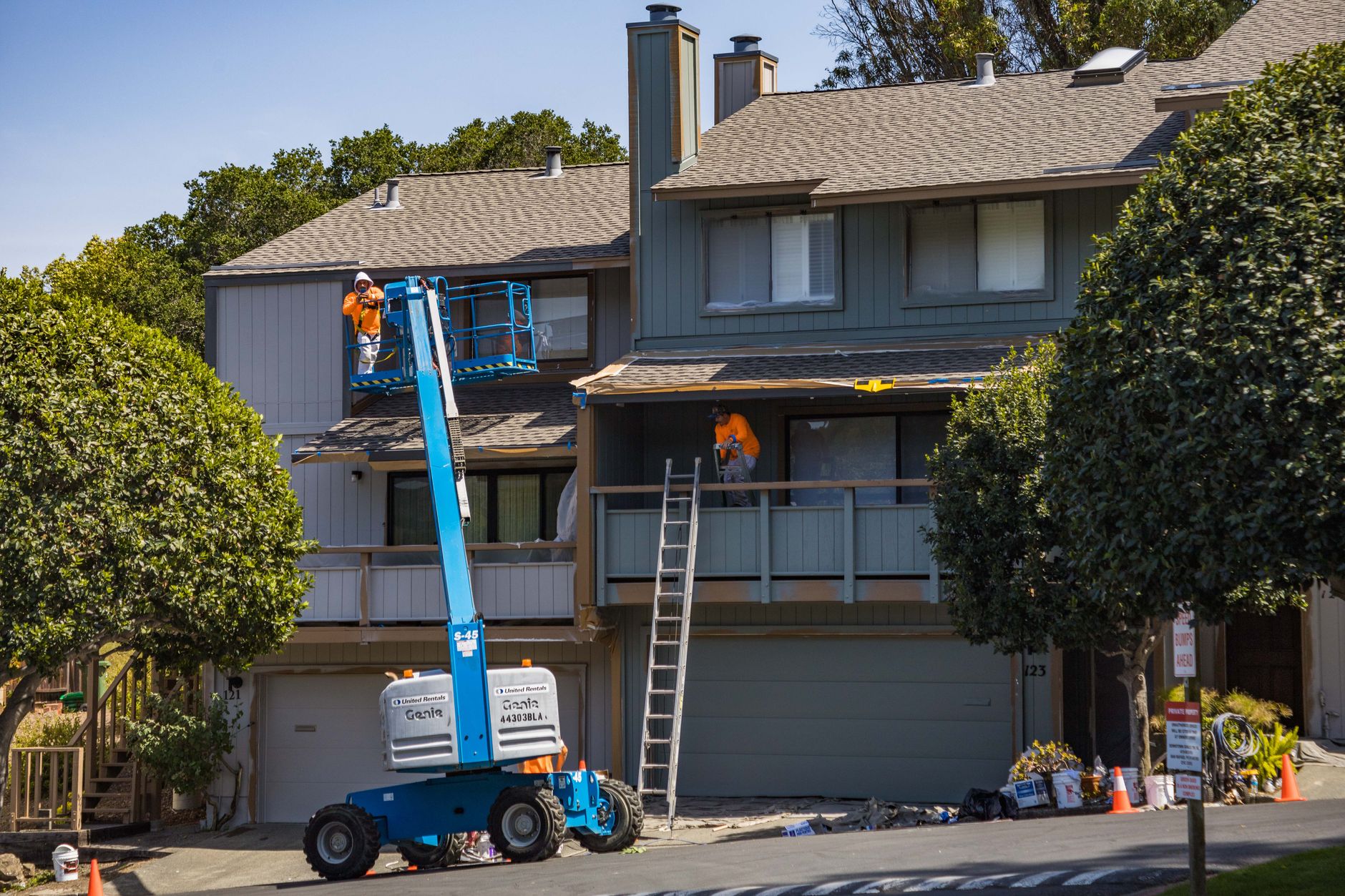
Two-story homes cost more to paint — not because there is more surface area (though there often is), but because the labor to paint above the first floor takes longer and requires different equipment. Tall extension ladders work in most situations. Scaffolding is required when the ground slopes away from the building, when trim work is extensive at upper-floor height, or when working around second-story balconies.
For canyon-rim homes in areas like Allied Gardens, Tierrasanta, or El Cajon where the back of the house drops steeply away from the building pad, scaffolding is often mandatory — not optional. Budget an additional $800–$2,000 for scaffold rental and setup on these sites. Any quote that doesn't mention access for a hillside home is either assuming ladders will work (they may not) or hasn't fully considered the scope.
Does paint quality affect exterior painting cost?
Yes, but less than most homeowners assume. A premium exterior latex — Sherwin-Williams Duration, Benjamin Moore Aura Exterior, Dunn-Edwards Evershield — runs $65–$95 per gallon. A contractor-grade product runs $30–$50 per gallon. The coverage difference means the premium product uses fewer gallons. On a 1,500 sq ft exterior requiring roughly 12–15 gallons of finish paint, the difference in materials cost is $400–$700. Against a $7,000–$9,000 total project cost, that is a reasonable investment in a longer-lasting result.
In San Diego specifically, UV resistance and salt-air tolerance matter more than in most U.S. markets. Coastal homes — anywhere within five miles of the coast — benefit from a product specified for marine exposure. Sherwin-Williams Loxon elastomeric and Dunn-Edwards Evershield are both commonly specified for coastal San Diego stucco. Ask your contractor to specify the paint product by manufacturer, product line, and color number in writing. That number should appear on your contract.
HOA color approval in San Diego
A significant percentage of San Diego homes sit within HOA-governed communities — Otay Ranch, Rancho Bernardo, Scripps Ranch, Tierrasanta, and dozens of planned communities in South and North County. Most HOAs require color pre-approval before exterior painting begins.
If your home is in an HOA, confirm the approval process before scheduling work. Most HOAs require a written request with paint chip samples or manufacturer color codes, and turn the approval around in 7–14 days. Skipping this step and painting in an unapproved color means repainting at your expense. A contractor who starts exterior work on an HOA property without confirming color approval has done this before — and not in a good way.

How to get and compare exterior painting quotes in San Diego
The three-quote rule exists for a reason, but only works if all three quotes are for the same scope. Here is what to look for when comparing:
- Surface prep listed as a line item — not buried in a single "painting" number
- Paint product specified by manufacturer and product name — not "premium exterior latex"
- Number of coats stated — two coats of finish plus primer is standard; one coat is not
- Crack repair scope defined — how many linear feet of crack repair, what material
- Contractor license number — verify on the CSLB license verification tool. In California, any painting job over $500 requires a valid C-33 license.
- Insurance certificate — general liability and workers' compensation, current
A written proposal that specifies all of the above takes twenty minutes to produce. A contractor who can't or won't provide that level of detail is telling you something about how the job will go.
Our license is CA #794402-C33. We have been painting in San Diego County since 2007. We do not use subcontractors — Joe or Alex is on every job. If you want a written estimate for your exterior, our exterior painting service page has the details, or call (619) 861-9377 and we will schedule a walkthrough.
When you should not paint your exterior
Paint is not the answer to every exterior problem. Here are four situations where painting costs money without solving the underlying issue — and where we will tell you that directly.
- Active foundation movement or structural cracks. Cracks that are growing, offset at the edges, or widen seasonally indicate structural movement — not just stucco settlement. Filling and painting over them hides the problem from the next owner but does not fix it. Get a structural or foundation assessment first.
- Active water intrusion. If there is water getting through the stucco at a window or door penetration, painting over it traps moisture behind the film and accelerates damage. The source of the leak needs to be identified and repaired before any painting begins.
- Failing elastomeric coating over compromised substrate. If a prior thick-film elastomeric coating is delaminating or bubbling, the substrate beneath it has a problem — usually moisture. Painting over a failing elastomeric without removing it and addressing the substrate will fail in the same pattern within two years.
- Cosmetic painting to sell a house with known defects. Disclosure laws in California are specific. A paint job applied to conceal known water damage or structural issues is not cosmetic — it is a disclosure problem. We do not take those jobs.
If you are not sure which category you are in, a walkthrough will tell you. We will not sell you a paint job if your house needs something else first. That is not generosity — it is just not worth it to us to paint a house that is going to fail and call us responsible for it.
For a written estimate on exterior painting in San Diego, see our exterior painting service or call (619) 861-9377. If you are researching costs for a broader project — interior included — our San Diego house painting cost guide covers both. For the best time to schedule exterior work, this post on San Diego exterior painting timing covers the marine layer and scheduling variables in detail. No forms, no automated quotes — Joe or Alex answers the phone.
FAQ
How much does it cost to paint a house exterior in San Diego?
A professional exterior repaint in San Diego runs $3.50–$5.50 per square foot for a standard stucco home in fair to good condition. Total project costs for a typical 1,500–2,500 sq ft home run $5,250–$13,750 depending on stucco condition, number of stories, trim complexity, and paint system. Significant stucco repair, hillside access, or premium elastomeric coatings push the number toward the high end.
How long does exterior house paint last in San Diego?
A properly applied exterior paint system on San Diego stucco lasts 7–12 years depending on paint quality, sun exposure, and coastal proximity. South- and west-facing elevations in direct sun fade faster. Coastal homes within a mile of the ocean benefit from a salt-air-rated finish system and typically need refreshing at the shorter end of that range. Premium products like Sherwin-Williams Duration or Dunn-Edwards Evershield extend the cycle compared to contractor-grade paints.
How long does it take to paint a house exterior in San Diego?
Most residential exterior repaints in San Diego take 3–5 business days for a standard single-story home and 5–8 days for a two-story. Add a day or two for significant stucco repair work that needs to cure before painting. Weather delays — specifically from the June Gloom marine layer on coastal properties — can push schedules by a day. We provide a written schedule before starting.
Do I need a permit to paint my house exterior in San Diego?
In most cases, no. A standard exterior repaint in the same or similar color does not require a permit in San Diego County or most incorporated cities. Work that involves structural stucco removal and replacement may require a permit depending on scope. If you are in an HOA, HOA pre-approval of the color is separate from a city permit and is always required before work starts.
What is the best time of year to paint exterior in San Diego?
Late September through early November and late February through April are the most consistently reliable windows for exterior painting in San Diego. Summer brings June Gloom fog on coastal properties and high afternoon temperatures inland that affect application conditions. Winter brings the highest chance of rain. Fall and spring offer the best combination of dry conditions, moderate temperatures, and low humidity. For a detailed breakdown, see our guide on the best time of year to paint exterior in San Diego.
Should I power wash before painting my house exterior?
Yes. Pressure washing is non-negotiable before exterior painting — it removes chalk, mold, mildew, dirt, and loose paint that would otherwise prevent proper adhesion. A professional crew will pressure wash at the beginning of the job and allow sufficient dry time (typically 48–72 hours) before primer and paint application. Do not apply paint to a wet or recently washed surface.
How do I verify a painting contractor's license in California?
Use the CSLB license verification tool at cslb.ca.gov. Enter the contractor's name or license number. The result will show the license type (look for C-33, Painting and Decorating), current status, and whether workers' compensation coverage is on file. A contractor whose workers' compensation is listed as “exempt” is a sole proprietor with no employees — which means no crew, which usually means subcontractors.
What is the difference between exterior painting and an elastomeric coating?
Standard exterior latex is a thin-film product — it coats the surface but bridges only minor hairline cracks. An elastomeric coating is a thick-film product that stretches and recovers with the substrate, bridging larger cracks and providing a waterproof film. Elastomeric costs more per gallon and requires more skilled application — misapplied, it traps moisture and causes its own set of problems. On San Diego stucco with significant thermal movement or a history of cracking, an elastomeric system is often the right specification. On a home in good condition, standard exterior latex is fine.
Penney's Professional Painting — exterior, interior, and commercial painting across San Diego County since 2007.
We will walk through your exterior, tell you what the prep scope actually is, and give you a written proposal that specifies every line item. No change orders for prep work we already knew about.
Walk the job with Joe or Alex.
Tell us what you're thinking. We'll come look, point out what we'd do differently, and only quote what we'd paint in our own house.